
Although living supposedly in a “free and democratic society”, Canadians are slowly being strangled and silenced by, among other things, Human Rights Commissions and the Codes they administer.
These Commissions work quietly in the shadows of our judicial system to deprive Canadians of their basic human rights, such as freedom of speech, thought, and religion, among other universally acknowledged human rights.
These Commissions are creating new political entitlements under the guise of “human rights” that would be inconceivable to previous generations. These new fantasy rights are based on the woke, progressive agenda and are supported by changes to Human Rights Codes that mirror and re-enforce that woke, progressive agenda.
The Beginnings of Human Rights Codes
Human Rights Codes are a recent development in Canada as Canada never had the equivalent of the U.S. Bill of Rights in our Constitution. The Ontario Human Rights Code, enacted in 1962, was the first in Canada. A federal Human Rights Act was not enacted until 1977. At the time, these changes were not so much a revolution but rather a consolidation of prohibitions on certain discriminatory practices set out in other legislation. The prohibited grounds were race, creed, sex, and ethnicity, and applied to areas of accommodation and employment.
Since 1962, however, it was expanded to include: contracts, the provision of services, workplace and sexual harassment, and vocational associations. Human Rights Codes are now one of the chief means of social control short of prosecutions under the Criminal Code.
Human Rights Codes and their enforcing Commissions were well-intentioned when they were initially established. Their purpose was to protect individuals from acts of discrimination, such as denying them accommodation, employment, or restaurant services because of their race, creed, sex or ethnicity.
Growth of the Human Rights Industry
With the expansion of Human Rights Codes, a whole industry of human rights grievances developed. This growth has been abused by amendments to Codes that rig the system in favour of complainants, and Commissions expanding their powers by allowing special interest groups to exploit Commissions to further their own purposes. For example, there is the requirement that governments appoint members to the Commissions, who are supposedly “human rights experts”, but who are in fact advocates and activists for left-wing special interest groups, such as feminists, LGBTQ and racialized groups. These members are not impartial or non-partisan, but come with their own left-wing, woke, progressive agenda. The requirement for “human rights expertise” is also found in the appointment criteria for members of Human Rights Tribunals which adjudicates the cases.
The takeover of the Commissions by these woke elites was made easier by the governing legislation which allowed the Commissions to pick and choose which complaints to proceed with and thereby promote. The Commissioners, therefore, selected complaints that would lead to the further expansion of special interest rights and privileges.
The process of the Commissions was corrupted by their ability to use any evidence they chose to reach a decision. Briefly stated: Human Rights Tribunals are not bound by the legal rules of evidence required by courts which, for example, excluded hearsay evidence. The ability of tribunals to choose any evidence they wished also provided them with the opportunity to ignore any evidence that would undermine the position of the complainants. As a result of these provisions, it is not difficult to predict the outcome of a complaint.
Lunacy of the Human Rights Commissions
These flaws in human rights legislation have led Commissions and Tribunals to descend into lunacy. Rather than maintaining the non-discriminatory requirements in the delivery of basic services and contractual relationships, Commissions/Tribunals have promoted new “rights and privileges” for special interest groups at the expense of Charter protected rights such as freedom of speech and religion. The public is required to accept the absurd policies of the Commissions and decisions of the Tribunals. The latter decisions may be acceptable to left-wing elites, but not to the majority of Canadians. It is significant that the decisions/policies of contemporary Human Rights Commissions/Tribunals are one of the major reasons that have caused Canada to become one of the most left-wing progressive countries in the world.
Lunatic Decisions of the Commission’s Tribunals
It is not possible to list in their entirety the many absurd policies/decisions handed down by Human Rights Commissions and Tribunals in recent years. However, a few examples will provide some understanding of the lunacy.
- The Canadian Human Rights Commission (CHRC) and Tribunal
a) Systemic Discrimination
The CHRC adopted the feminist concept of “systemic discrimination”, which means that although discrimination may not be evident, it is, nonetheless present in the attitudes, practices and policies affecting minorities. The remedy to systemic discrimination was Affirmative Action programs and quotas in hiring.
b) Transgenderism
The CHRC took an interest in the issue of transgenderism and ordered the Federal Correctional Services Canada [CSC] to pay (that is, the taxpayer to pay) the costs of inmate reassignment surgery. This occurred even in cases where the accused was not aware that he/she was born in the wrong sex until after conviction and being sent to a male penitentiary. The rate of transfer approvals reached 80% in the first year of this policy. The policy was then modified so that the transfers could be made on a case-by-case basis. That is, each transfer request was assessed according to the risk to other inmates, as well as to the history of violence of the convicted inmate. As of October 2025, there were 90 transgender individuals in federal prisons. According to CSC data, 73 of these were housed in men’s prisons and 17 in women’s prisons.
c) Women in the Military
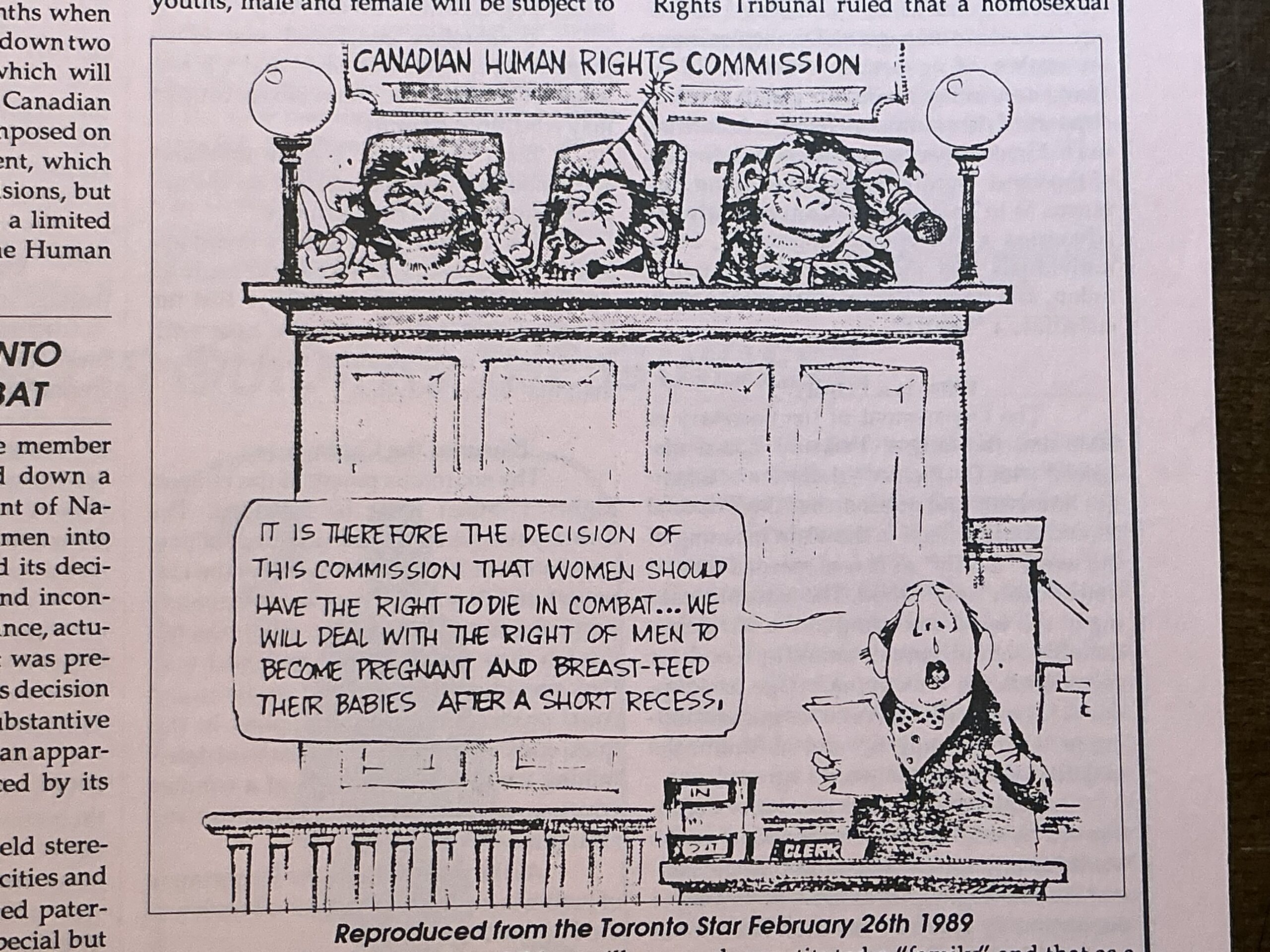
In the 1989 decision of Brown v. Canadian Armed Forces, the Canadian Human Rights Tribunal decreed that women should be admitted to all units of the Canadian Armed Forces (CAF) including combat units but excluding submarines (later permitted). This decision was based on the feminist concept that men and women were equal and interchangeable in all respects. This ignored the fact that females have a different stature, weight, lower lung and heart capacity and have less physical stamina than males. Nonetheless, the CAF was determined that women comprise 25% of the armed forces. Despite billions of dollars spent by the CAF in the recruitment, training and struggling to retain women in the military over the past nearly 40 years, by May 2023 the number of women in the military rose only to 16.5% rather than to the objective of 25%, of which only 4.8% were combat personnel. On April 21, 2026, Lt.-General Erick Simoneau, chief of military personnel stated, “We’re having great difficulties because the bulk of our occupations and positions that we have to offer to the Canadian population is in the combat arms in the army. So, until we can convince women to join the army and then the combat arms, I’m very pessimistic about meeting the 25% target.” Obviously, despite feminism, Canadian women are not drawn to military service.
d) Christmas is Discriminatory
In October 2023, the CHRC released a report called: Discussion Paper on Religious Intolerance. The paper concluded that the celebration of Christmas is discriminatory because of Canada’s history of colonialism and racism and that the statutory holidays related to Christmas and Easter were therefore discriminatory against religious minorities. Non-Christians have no problem with a Christian holiday. A Leger poll taken in 2022 found that 92% of those coming from a non-Christian culture in Canada stated that they are not offended with Christian celebrations.
Internal emails obtained under the Access to Information Act indicated that CHRC officials were impressed by its report, referring to it as “a great job”, “super-clear and informative, I really like it.”, “Congratulations for getting this important material into final form,” “a great paper”, “fantastic reference”. The Commission was therefore caught off guard by the backlash that occurred over this report. The policy statement raised questions in Parliament. The Quebec National Assembly condemned the report, and the Canadian public was deeply offended by it. In view of this backlash, the CHRC was forced to curb its enthusiasm for its proposed anti-Christmas policy.
e) Hostility to Traditional Values
In 2011, Damian Goddard, a devout Catholic, was a successful TV and radio sports broadcaster and leading anchor at Rogers Sportsnet. Mr. Goddard had written on Twitter his support for the traditional marriage of a man and a woman. This understanding of marriage is a foundational belief of many religions. He was fired by Rogers on the spot after 13 yrs of loyal service. Mr. Goddard took his case to the Canadian Human Rights Commission claiming that his firing was a case of religious discrimination. In 2013 the Commission dismissed his complaint on the basis that there was no link between Mr. Goddard’s religion and the termination of his employment. Clearly, there was no link either between the Commission’s decision and logic.
- Provincial Human Rights Commissions and Tribunals
a) British Columbia Human Rights Tribunal
The province of British Columbia is currently in a topsy-turvy state under the management of its unpopular and remarkably inept NDP Premier, David Eby. Eby’s crazy policies, however, are uniquely matched by the crazy decisions of the British Columbia Human Rights Tribunal (“BC HRT”). An example of a ludicrous decision was the January 2025 decision in Wiebe v. Olsen in which the Tribunal fined a woman $10,000 because in private conversation with the complainant, a supposed “friend”, she had expressed concerns over transgenderism. This decision of the BC HRT is of particular concern because it has assumed jurisdiction over, and the power to police, private communication between friends as well as impacting freedom of expression. In the recent March 2026 decision in J. v. The Governing Council of The Salvation Army in Canada the BC HRT dismissed without a hearing a complaint and declared that a woman, who was the victim of sexual assault, did not experience discrimination when the Salvation Army, where she resided, required her to transfer to a building, explicitly established for transgender females. The complainant objected to this transfer stating that she did not want to reside with transgenders because of her previous sexual assault. The BC HRT, however, stated that the woman was not adversely impacted by the Salvation Army’s transfer to the building, since the complainant and the residents of the building were the same sex.
In February 2026, the BC HRT fined a former BC school board councillor in Chilliwack, Barry Neufeld, a vicious $750,000 for openly opposing gender ideology taught in BC schools. This Commission, however, was no stranger to awarding penalties for what it considered incorrect thinking. The Vancouver Aboriginal Child and Family Services Society was fined $150,000 for allegedly basing a custody decision on stereotypes. The BC HRT claimed that the child protection law was “Eurocentric”, i.e. based on European cultural assumptions. Also in 2026, the BC HRT denied a complaint from a white political science professor at Simon Fraser University named Josh Gordon. He had complained that he had suffered discrimination on the basis of his political beliefs since he had publicly objected to the policy of Diversity, Equity and Inclusion (DEI) and held other conservative views about decriminalizing drugs, and Indigenous communities suffering under colonialism. The BC Tribunal refused to hear his complaint, stating that Mr. Gordon’s belief lacked “the necessary cohesion and cogency” to warrant protection. Briefly stated, the members of the Tribunal did not like Mr. Gordon’s views and therefore refused his complaint.
b) Alberta Human Rights Commission
In June 2023, a complaint was raised against a woman who had distributed flyers in opposition to an LGBTQ rainbow crosswalk installed in her neighbourhood. In her defence the woman stated that the purpose of the flyer was to warn parents about the potential consequences of children pursuing the pathway of transgenderism. The Commission accepted the complaint and a two-week hearing before the Alberta Human Rights Tribunal is scheduled to take place in September 2026.
In May 2025, the Commission rejected a complaint alleging discrimination on the basis of sex. This case arose when a mother and her 14-year-old daughter encountered a bald male in full sexual fetish gear, including rubber breasts and a black thong outlining his penis, in a female change room at the Bonnie Doon Leisure Centre in Edmonton. The complainant had argued that the facility’s policy which allows males who self-identify as women, to enter the women’s-only areas, compromised the privacy, dignity and safety of all females. The decision not to hear the complaint was upheld by the Alberta Court of King’s Bench on June 10, 2026, on procedural/technical grounds that only a lawyer would understand. The Trudeau government has appointed many daft progressive judges to the Bench who are prepared to back the progressive Tribunals. This was an example of it.
c) Ontario Human Rights Tribunal
In the November 2022 decision, Lisikh v. Ontario (Education) the Ontario Human Rights Tribunal found no issue with the case in which a high school student had been barred from a government sponsored black-only summer programme. The panel of the Tribunal arrived at this decision claiming that people cannot claim discrimination when programs exclude them since racial discrimination on the grounds of colour is not one that can be or has been successfully claimed by people who are white and non-racialized. In other words, white people cannot claim discrimination.
Contempt for Current Human Rights Commissions/Tribunals
Human Rights Commissions and Tribunals are being used as tools by the left-wing progressives. They see themselves as the defenders and moral guardians of society’s progressive agenda. They believe they are responsible for stamping out non-believers or dissenters of woke policies. These Commissions/Tribunals, by practicing a policy of “everyone is equal, but some are more equal than others”, have betrayed the integrity of the justice system and are antithetical to the rights and freedoms guaranteed by the Charter. They protect only the ideology of the left-wing, woke, progressives, and therefore cannot reasonably be considered objective, fair or non-partisan. More importantly, they pose a serious threat to freedom of speech, the essential requirement for a sustainable, flourishing “free and democratic society”.
Consequently, they must be restructured without delay so that they provide only impartial decisions, maintaining non-discriminatory decisions regarding accommodation, services and contracts. The restructuring should include, among other items, eliminating the appointment to the Commissions of political activists and representatives of special interest groups; restricting the categories of discrimination over which the Commissions have jurisdiction to: accommodation, services and contracts; prohibiting the discretion of the Commissions to dismiss complaints; and preventing the Commissions from misapplying evidence.
Parliament and the provincial legislatures created these monstrous agencies, and they are responsible to correct these errors. Until such time as they have been restructured, these Commissions/Tribunals should be regarded with well-deserved contempt and avoided at all costs. This is especially true for white males, particularly those who have conservative or traditional perspectives.